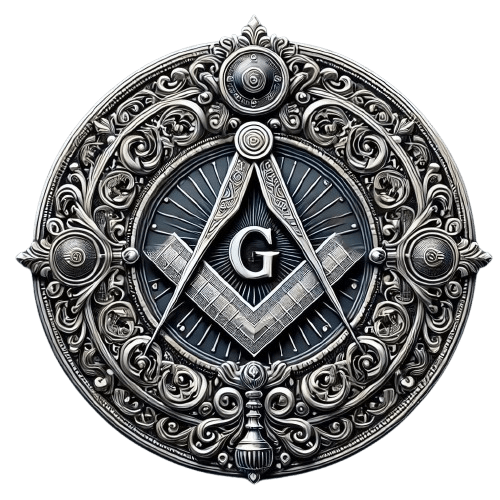
The connection between Freemasonry and American law enforcement begins with the oath. A peace officer makes a formal, witnessed commitment to uphold the law, protect his community, and conduct himself with integrity. A Mason takes a formal, witnessed obligation of brotherhood and moral conduct. Both traditions understand that some forms of service require a man to bind himself publicly to something larger than his own judgment — and that the binding, once made, follows him outside the ceremony. In the American West especially, where civil society and the fraternity were built in the same decades by many of the same men, the two obligations overlapped more often than most people know.
The Frontier
In the nineteenth-century American West, the institutions of civil society — courts, churches, schools, lodges, and law — were being built at the same time, often by the same men. A sheriff was frequently a Mason not because the fraternity recruited lawmen but because the same character that made a man fit for one made him suitable for the other. Integrity, steadiness under pressure, willingness to stand for the community when it would be easier not to — these were qualities the lodge looked for in a petitioner and qualities a frontier town needed in a peace officer.
Kit Carson, initiated as a Mason on March 29, 1854, at Montezuma Lodge No. 109 in Santa Fe, spent his life in roles that demanded exactly that overlap. Scout, mountain man, Indian agent, Army officer: Carson was a man who moved between worlds — Anglo, Hispanic, Native American — and was trusted in all of them. He became a charter member and the first Junior Warden of Bent Lodge No. 42 in Taos, a lodge founded by the men who were simultaneously building New Mexico Territory's civic institutions. When he died in 1868 at Fort Garland, Colorado, the lodge his brothers named for him — Bent Lodge — eventually purchased his home and preserved it. His Masonic brothers kept his memory the same way they had known him: as a man of his word.
Pat Garrett, the Lincoln County sheriff who hunted down Billy the Kid in 1881, was a Mason. He is buried in the Masonic Cemetery in Las Cruces, New Mexico. The fraternity's presence at the end of his story, as at the end of many a Western lawman's, was not incidental. It was the community that had known him, in the lodge room as on the street.
The Oath and the Obligation
What distinguishes a peace officer from a simple citizen with authority is not the badge. It is the oath — the public commitment to something beyond personal interest. A deputy who takes his oath seriously understands that the law applies to him as much as to anyone else. The square, in Masonic symbolism, is the tool that tests whether a stone is true — whether it is what it presents itself to be. A Mason uses it on himself first.
This is the deepest point of contact between the two traditions. Both ask a man to hold himself accountable to a standard that does not bend for convenience. Both ask him to extend that accountability to the people around him — his brothers, his community, the strangers who depend on him to be what he said he would be. Neither tradition tolerates the man who uses his position for personal advantage. The peace officer who shakes down the citizens he was sworn to protect, the Mason who exploits his fraternal connections for private gain — both have violated something fundamental, and both traditions have always said so.
The American West and Colorado
Colorado's own history makes this connection visible. When the first Masons gathered in Auraria in 1858, they were among the same wave of men who would soon be organizing the territory's courts, electing its sheriffs, and building the civic structures that transformed a gold-rush camp into a functioning society. The lodge and the law office occupied the same world, and were often occupied by the same men. The values they shared were not coincidence. They were the common inheritance of men who understood that a community without obligation was not a community at all.
Fort Garland, Colorado, where Kit Carson served as post commander from 1866 to 1867 before his death in 1868, stands in the San Luis Valley — the oldest non-indigenous settlement in the state. The same territory where Auraria Lodge met in a tent in 1858 was being patrolled by men who carried both a badge and a fraternal obligation. The overlap was practical as well as philosophical. In a place where government was thin and distances were long, a man's character was often the only law that functioned.
What It Means in the Lodge Room
Freemasonry has never been a law enforcement organization, and no serious person has claimed otherwise. What the fraternity has been, consistently, is an organization that attracts men who take their obligations seriously — whether those obligations are to the community, to their brothers, or to the principles they swore to uphold when they received the apron.
The men of Centennial Lodge No. 84 who carry a badge do not carry it into the lodge room. That is the point. The apron covers all distinctions: rank, occupation, background. In lodge, a police officer is a brother among brothers, subject to the same obligations and the same standard as every other man present. What the lodge asks of him is what it asks of everyone — honesty, integrity, care for the men beside him, and conduct that would not shame either the fraternity or himself.
That is not a small thing. In a city, in an era, when the relationship between law enforcement and community is complicated and sometimes strained, a tradition that asks a man to hold himself to a standard regardless of whether anyone is watching has something to offer. The lodge has always known this. It is one of the oldest things the Craft teaches.
SOURCES & REFERENCES
Kit Carson Home and Museum, Taos, New Mexico — kitcarsonhome.com
Intermountain Histories, The Kit Carson Home & Museum — intermountainhistories.org
True West Magazine, Were Freemasons Prevalent in the Old West? — truewestmagazine.com
Wikipedia, Pat Garrett — en.wikipedia.org (resting place: Masonic Cemetery, Las Cruces, NM)
Grand Lodge of Colorado A.F. & A.M. — coloradofreemasons.org
Fort Garland Museum — History Colorado — historycolorado.org